R&S Architecture And B&S Architecture Of Optical Network ROADM
In the mid-1990s, optical communication systems were specifically designed to transmit voice traffic generated by telephone networks. The characteristics of phone traffic are well suited to a ring topology, as shown in the figure below.

However, the emergence of the Internet changed this logic. For Internet users, they are more likely to access Internet content in different cities or even different countries than in nearby areas. Therefore, optical networks have evolved from ring and point-to-point topologies in the 1980s to the current mesh topology, and with the development of coherent technology, the combination of transmission and network technologies has built a more efficient optical network . The Mesh structure is shown in the figure below.
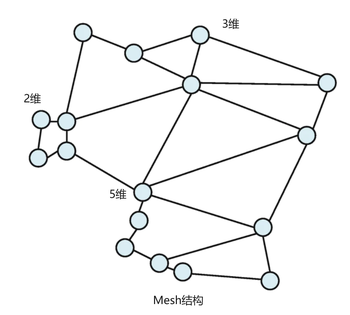
In the above-mentioned multi-dimensional node, the forwarding of the optical path is handled by a device called a reconfigurable add-drop multiplexer (ROADM). The main component of ROADM is the wavelength selective switch (WSS), whose logic diagram is as follows:

In the above diagram, the WSS acts as a multiplexer. The WSS is able to select any set of wavelengths from any of its input ports and direct them to the output port. As a demultiplexer WSS, the WSS is capable of selecting any set of wavelengths from its input port and directing them to any output port.
The physical structure of the WSS where the multiplexer works is shown in the figure below.

After the Front-End optics optical device, the input WDM signal is wavelength demultiplexed through the diffraction grating. Back-End Optics directs multiple wavelengths onto a mirror that spatially directs each wavelength to the desired output port. Reflectors can be built based on microelectromechanical machines (MEMs) or liquid crystal on silicon (LCoS) technology. Output diffraction gratings (one for each output fiber) multiplex the incoming WDM signals and send them to the corresponding output ports.
Combining multiple WSS and power splitters (splitters), two main ROADM architectures can be designed: ROADM R&S and ROADM B&S.

R&S ROADM architecture: The WSS is placed on the input and output fibers. R&S architecture avoids excessive power allocation in high ROADM;
B&S ROADM architecture. The power splitter is placed on the input fiber and the WSS is placed on the output fiber. The R&S architecture is cost-effective and reduces narrowband filtering.
Generally speaking, the R&S architecture is better than the B&S architecture because it provides lower insertion loss for N-dimensional large nodes. However, compared to the R&S architecture, the B&S architecture avoids additional filtering and polarization-related losses. In addition, from an economic point of view, B&S saves N*WSS, making the solution more affordable.
DWDM Solution, ROADM products and technology questions, pls consult us, Taylor Huang, Sale Engineer.


Comments
Post a Comment